2019
2025

At JBS, our sustainability framework is a disciplined, business-focused approach that reinforces the economic performance of our core operations, accelerates progress to improve efficiency and reduce waste, and helps to build long‑term resilience and mitigate food insecurity across our value chain. We produce affordable high-quality food products while striving to reduce waste, expand circular economy opportunities, and protect environmental quality.

Our ambition is to help feed a growing world while endeavoring to reduce the environmental footprint of our operations and the broader food value chain. Our opportunity is to help address increasing global demand for protein responsibly, and we believe that effective management practices improve efficiency, enhance productivity, and transform waste streams into new co-products and renewable energy that contribute to long-term business success.
Our sustainability framework is built on three key pillars:
• Maintain Excellence
• Drive Progress
• Build Resilience
Responsible growth. Sustainable future.
Our Purpose: To feed a growing world responsibly and sustainably
Maintain ExcellencE
Building on strong foundations, prioritizing safety, integrity, and a culture of care, to protect our people and strengthen trust across our value chain.
Our Goals
Health & Safety: Improve Global Safety Index by 10% year over year
People Development: Continue providing life‑changing development and educational opportunities for team members and their families
Drive Progress
Accelerating near- and long-term climate, energy, and water initiatives to reduce environmental impact and strengthen resilience.
Our Goals
Climate (Near-term): Reduce Scope 1 & 2 emissions intensity (tCO₂e/t of finished product) by 30% by 2030 (2019 baseline)
Climate (Long-term): Reduce Scope 1 & 2 emissions intensity (tCO₂e/t of finished product) by 70% across JBS processing facilities by 2050 (2019 baseline)
Energy: Reach 60% renewable electricity by 2030
Water: Reduce water use intensity (m³/t of finished product) by 15% by 2030 (2019 baseline)
Build Resilience
Mitigating risk across the value chain through responsible sourcing, transparency, and supporting agricultural producers.
Our Goals
Supply Chain Resiliency: Support farmers with their adoption of regenerative practices, innovative technologies, and agronomic technical assistance to enhance productivity and mitigate GHG emissions
Supply Chain Transparency: Improve transparency of priority agricultural supply chains to address deforestation risks in Brazil
The interconnected challenges of climate change and food insecurity require bold action, innovation, and collaboration across industries, governments, and communities. At JBS, we are dedicated to advancing agriculture and food production systems to not only feed the world, but also to protect it. By partnering with farmers and ranchers, customers, researchers, policymakers, industry groups, and other stakeholders, we aim to develop solutions that balance sustainability with food production.
For more than a decade, we have measured, monitored, and reported direct and indirect greenhouse gas (GHG) emissions, voluntarily disclosing data through the GHG Protocol Brazil Public Emissions Registry, the Carbon Disclosure Project (CDP), the Paraná Climate Seal, and other regional regulatory frameworks and platforms. These disclosures have earned JBS the GHG Protocol Gold Seal and the Paraná Climate Seal Gold.

A Shared Commitment
The health and safety of our team members is paramount. Across all regions, we integrate health and safety into our organizational fabric, tailoring strategies to local contexts while maintaining global standards. Our Team Member Health and Safety Global Policy serves as the foundation for our strategy and management approach, supporting alignment with applicable regulatory requirements in every country where we operate.
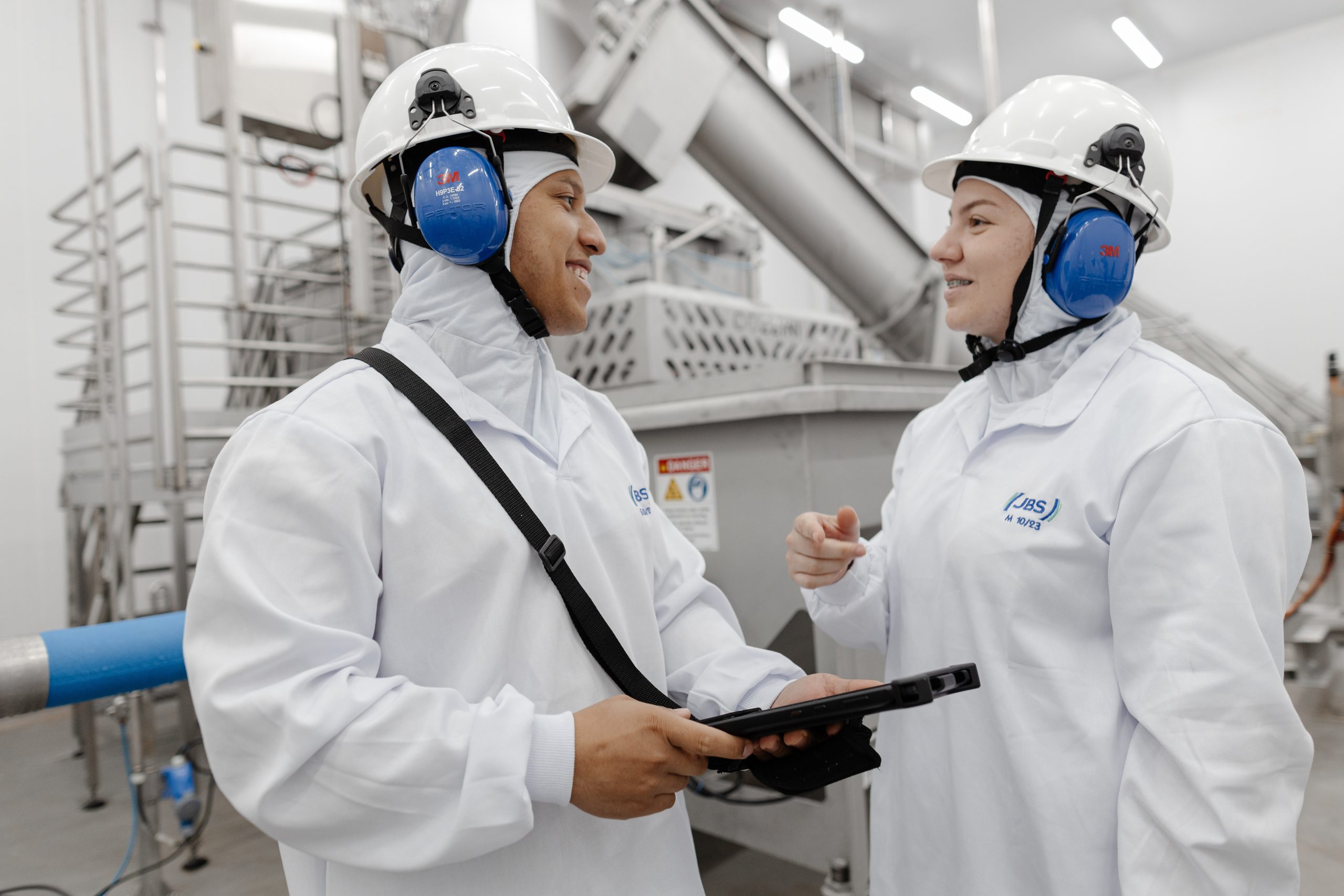
Engage, develop, and train employees, giving them responsibility for ensuring and fostering a safe and healthy work environment;
Anticipate and prevent incidents and accidents, assuming that all accidents are preventable;
Drive continuous improvement of our processes, machinery, and equipment, while implementing measures to eliminate or minimize incidents;
Ensure compliance with legal requirements, our own health and safety programs, and other applicable health and safety standards;
Develop and disseminate a culture of health and safety, individual accountability, and shared vigilance of values, with leaders as role models.
In Brazil, JBS operates under an Integrated Health and Safety Policy that supports its Self-Management Health and Safety Program. This program standardizes procedures related to Occupational Health and Safety, monitoring compliance with legal and internal requirements while driving continuous improvement. Each business unit has dedicated health and safety leaders reporting to the Corporate Team, with site-level teams structured according to Regulatory Standard 4 (NR4). Additionally, all units in Brazil have an Internal Commission for the Prevention of Accidents at Work (CIPA), which meets monthly to address process improvements and participate in inspections, risk mapping, and safety campaigns.